Tagliolini · First course
Tagliolini with butter and sage: the thin sfoglia recipe
The finest cut of the sfoglia, for a dressing that does not cover it
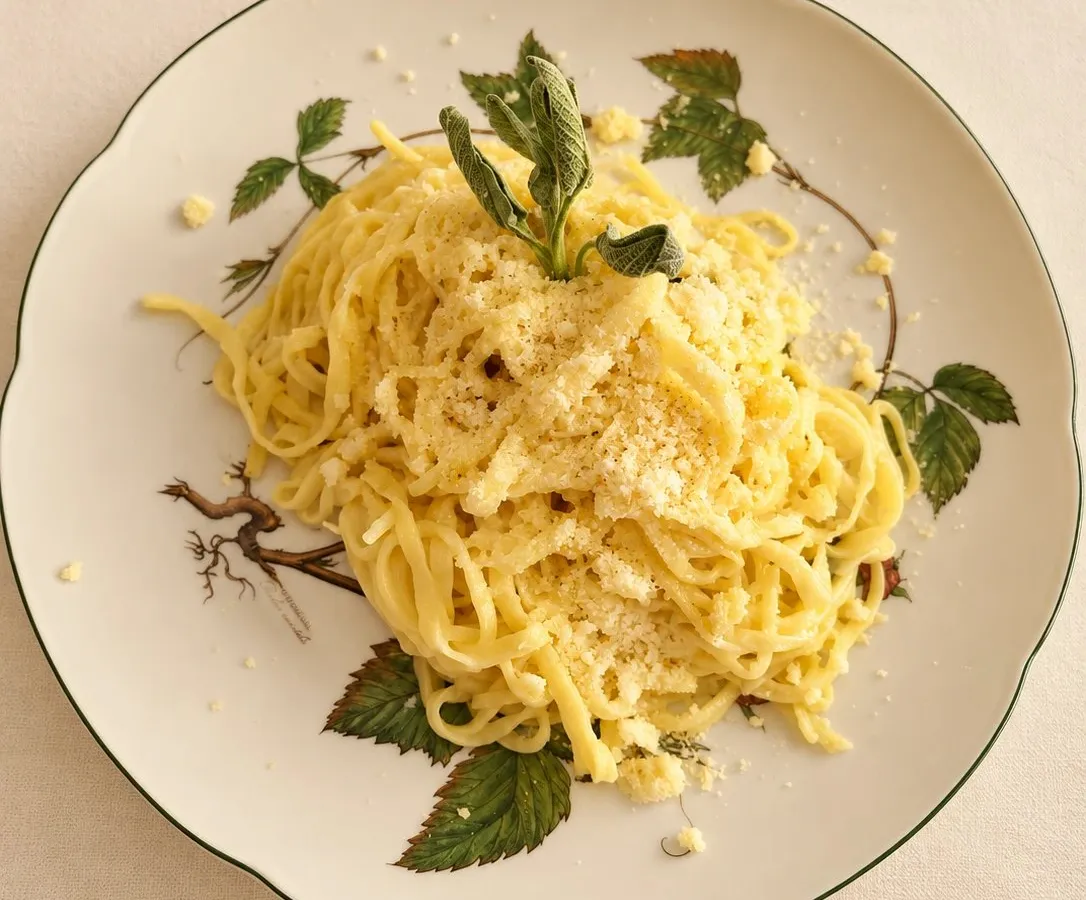
Tagliolini al burro e salvia are the dish for evenings when the sfoglia, the sheet of egg pasta, is already made and there is no time for ragù. They are also the dish of celebrations, when a truffle comes into the house and you need something that will not cover it. A sheet as thin as a veil, butter taken to the colour of a hazelnut, sage that fries for a second and Parmigiano: ten minutes, if the pasta is ready, and everyone is at the table.
Here is our version: three eggs and three hundred grams of flour, cut at 2 to 3 millimetres and butter treated with respect. It is a simple recipe, but simplicity in the kitchen forgives nothing.
Why the tagliolino wants a thinner sheet
Tagliatelle are rolled to about a millimetre, tagliolini to no more than 0.7 mm. This is not fussiness. A ribbon 8 millimetres wide and a millimetre thick has a cross section that carries a thick ragù; a 2 millimetre ribbon of the same thickness would become a square spaghetto, hard and out of proportion. The house rule is that width and thickness go together: the narrower you cut, the thinner you must roll. All the measurements are in the guide to pasta thickness by shape.
There is a question of taste too. A thin tagliolino cooks in a minute and stays soft, almost silky, and the butter coats every strand. A finer sheet also has more surface for its weight, so it takes up more dressing with less fat. To roll it without tearing you need a rested dough and a long pin: the guide on rolling pasta by hand explains the gestures one by one.
The browned butter
Melted butter is one thing; browned butter is another. Heated over a medium flame, butter first foams, which is the water evaporating, then the foam subsides and the milk proteins on the bottom begin to toast. That is where the smell of hazelnut and biscuit is born. The sage goes in at that moment, for a few seconds: it turns crisp and gives up its oil. A moment later the heat goes off, because there are ten seconds between nutty and burnt.
The version in broth
Before the butter there was broth. Tagliolini in capon broth were one of the typical first courses of the tradition, or the dish for anyone who was unwell and needed something warm and light. They are cooked straight in the broth, for a minute, and served with Parmesan. With passatelli they make up the pair of Sunday soups of Romagna.
How to serve them
In a warm deep plate, with the butter bound to the pasta by a small ladle of cooking water. The Parmigiano goes in off the heat, or it turns stringy. If there is truffle, it is shaved over at the last moment, in fine slices, and nobody speaks for a good minute.
Ingredients
For the pasta
For the dressing
Tick the ingredients as you go. Amounts adapt to the number of servings.
Weigh the eggs, find the flour
Flour type the weight
Cut shapes: weight of the eggs × 1.66, the classic sfoglia formula. The rule is in the guide to the basic dough.
Method
-
The dough
Make a well with the flour on the board, break the eggs into the middle and beat them with a fork, drawing in the flour a little at a time. Knead with the heel of your hand for 10 minutes until the dough is smooth, elastic and no longer tacky.
-
The rest
Wrap the dough in cling film and let it rest for 30 minutes at room temperature. The gluten relaxes and the sheet can be rolled thin without tearing.
-
The very thin sfoglia
Roll the sheet with the pin until you can see the board through it, about 0.7 millimetres. Leave it laid out to dry for 10 to 15 minutes: it should lose the moisture on the surface but stay foldable.
-
The cut
Roll the sheet up loosely and cut ribbons 2 to 3 millimetres wide with a well sharpened knife. Open the nests at once with your fingers and lay them on a lightly floured tray, or one lined with baking paper.
-
The browned butter
Put the butter in a wide pan over medium heat. When the foam subsides and golden specks appear on the bottom, add the sage and wait for the butter to take colour and smell of hazelnuts. Take it off the heat at once.
-
Cooking
Drop the tagliolini into plenty of boiling salted water and lift them out after a minute, as soon as they come back to the surface. They are thin and cook in no time.
-
Finishing and serving
Lift the tagliolini with tongs into the pan of butter with a small ladle of pasta water. Toss gently until the dressing turns creamy, add the Parmigiano off the heat and serve at once, with shavings of truffle if you have it.
Alternative method: with the pasta machine If you roll the sheet with rollers
Tagliolini are the shape where the machine gives the most: they want a very thin, even sfoglia, and that is exactly what the rollers are good at.
- Divide the dough into four pieces and keep them covered.
- At the widest setting fold in three and pass again four or five times, until the strip is smooth and even at the edges.
- Go down one setting at a time as far as the seventh or eighth out of nine, about 0.7 millimetres: the strip should let the light through.
- Let the strips dry for ten minutes laid out on the board, no longer: if they dry too much they break as you cut them.
- Cut with the narrow roller on the machine and open the nests at once with your fingers, dusting them with semola, the durum wheat semolina.
The rolling pin remains our choice: the reason is in the guide to rolling the sfoglia by hand.
Frequently asked questions
What is the difference between tagliolini and tagliatelle?
The width and the thickness. Romagna tagliatelle are 7 to 8 millimetres wide and rolled to about a millimetre; tagliolini are 2 to 3 millimetres wide and the sheet is no more than 0.7 millimetres. That is why they cook in a minute and want light dressings.
Can I serve tagliolini in broth?
Certainly, it is the oldest way of serving them. Cook them straight in boiling capon or meat broth for a minute and take them to the table with grated Parmesan. In Romagna they are one of the traditional first courses in broth.
Can I make them in advance?
Yes. Fresh, floured and covered with a tea towel, they will keep for a day in the fridge. If you want to keep them longer, let them dry out completely on the tray, turning them now and then, or freeze them in nests.
Do they work with a pasta machine?
Yes, and it is perhaps the shape where the machine does best, because the sheet has to be very thin and even. The roller method is set out just above: seventh or eighth setting out of nine, then cut with the narrow roller.
Keep kneading
Similar recipes
 Strozzapreti
Strozzapreti romagnoli
The weekday pasta, no eggs and no equipment
 Gnocchi
Potato gnocchi with butter and sage
Thursday is gnocchi day
 Ravioli
Ravioli di ricotta e spinaci
The simplest filling, if the ricotta is the right one