Passatelli · Beyond the sfoglia
Passatelli in brodo: the Romagna bread and Parmesan recipe
Bread, cheese and eggs: the broth of feast days and leftovers
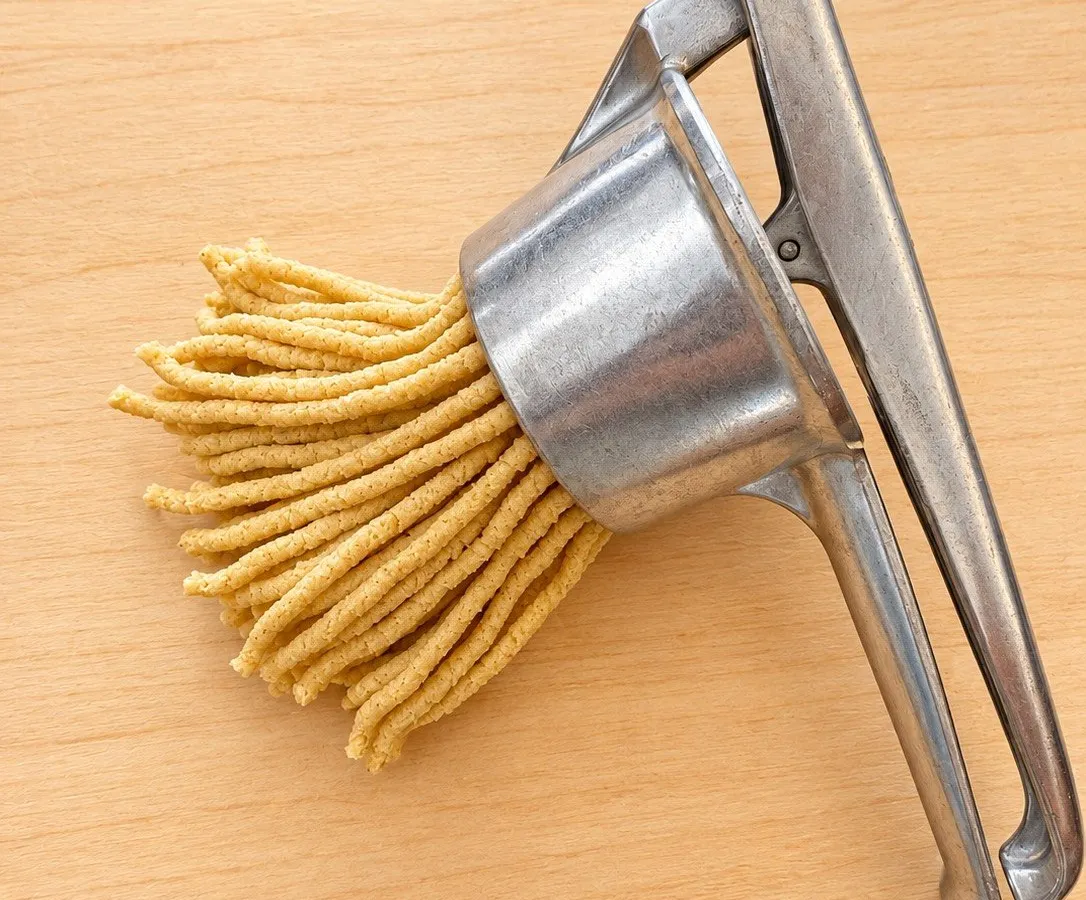
Passatelli are the broth people made when there was little in the house and they wanted a feast anyway. Grated dry bread, the Parmigiano that was never missing from the larder, three eggs and yesterday’s broth: ten minutes and Easter lunch was ready. Even now, in the houses between Cesena and Pesaro, the sound of the iron pressing the mixture over the pan is the sign that Sunday has begun.
The mixture: getting the texture right
The whole recipe lies in the ratio of bread to cheese, which in Romagna is one to one: as much grated bread as Parmigiano, and one egg for every 50 grams of each. But the proportions are only a starting point, because stale bread is never the same twice and neither are eggs. Your hand decides: the mixture should come together into a firm, pliable ball that takes pressure without splitting. The nutmeg is compulsory, the lemon zest is the Romagna signature that sets it apart from the version made in the Marche. The half hour of rest is not a flourish. Without it the bread does not take up the egg and the passatelli crumble in the broth.
The iron, the ricer and the hand
The passatelli iron is a domed metal disc with wide holes and two wooden handles. You set it on the mixture and press with the whole weight of your body, and the passatelli come out thick and irregular, with a rough surface that holds the broth. A potato ricer with the wide hole disc does almost the same job and lives in every kitchen. In our guide to pasta making tools we explain what to look for if you want to buy a real iron. However you make them, cut them at four or five centimetres: longer and they break, shorter and they look like little gnocchi.
The right broth
A passatello has little flavour of its own: it tastes of bread and cheese, and the rest has to come from the broth. So you need a full meat broth, capon or hen with a piece of beef, made unhurriedly and well degreased. We make it in the recipe for cappelletti in brodo and we always make twice as much: what is left over is the next day’s lunch, with passatelli in it.
The seafood version, without broth
On the coast, from Cervia down to Cattolica, passatelli have taken another road: cooked in salted water or a light broth, lifted out with a slotted spoon and tossed in a pan with clams, razor clams and a few prawns, garlic, oil, a cherry tomato and parsley. It sounds like heresy, but it works because the cheese in the mixture is cooked and does not clash with the seafood. The trick is to cook them a minute less and finish them in the pan with a ladle of their own water, so they stay whole.
At the table
Passatelli in brodo go straight to the table, in warm bowls, with Parmesan on the side and pepper for those who want it. They wait for nobody: after ten minutes in the broth they turn to porridge. As our grandmother used to say, and she was a real azdora, the woman who ran the farmhouse kitchen, you make passatelli once everyone is already sitting down.
Ingredients
For the passatelli
To serve
Tick the ingredients as you go. Amounts adapt to the number of servings.
Method
-
The broth
Bring the broth to a gentle simmer in a wide pan. If you are making it from scratch, follow our double broth: the recipe is on the cappelletti page. Taste it and adjust the salt now, because passatelli are not salted as they cook.
-
The mixture
In a bowl mix the breadcrumbs, the Parmigiano, the nutmeg, the lemon zest and a pinch of salt. Add the eggs and the soft butter and work it with your hands until you have a firm, compact ball that neither crumbles nor sticks to your fingers.
-
Getting the texture right
If the mixture cracks, add a spoonful of warm broth. If it is soft and sticky, add a spoonful of breadcrumbs. It depends on the bread and on the size of the eggs: your hand should feel a pliable dough, like biscuit dough.
-
The rest
Wrap the ball in cling film and leave it to rest for 30 minutes at room temperature. The bread absorbs the moisture from the eggs and the mixture becomes even: this is the step that stops passatelli breaking up.
-
Through the iron
Divide the mixture into pieces. Press each piece with the passatelli iron, or push it through a potato ricer fitted with the wide hole disc, holding it straight over the pan. When the strands reach four or five centimetres, cut them with a knife and let them fall into the broth.
-
Cooking
Cook at a gentle simmer for two or three minutes: the passatelli are ready when they have all risen to the surface. Turn the heat off at once, let them settle in the broth for a minute and serve with Parmesan grated at the last moment.
Frequently asked questions
Can I make passatelli without the iron?
Yes, a potato ricer with the wide hole disc is what most families use today. The traditional iron, a domed perforated disc with two wooden handles, gives thicker and more irregular passatelli, but the result in the bowl is very similar.
Why do my passatelli fall apart as they cook?
Almost always because the broth is boiling too hard or because the mixture is too wet. The broth should barely tremble rather than roll, and the mixture should be firm. A Parmigiano that is too young or a crumb that is too fine both add to the problem.
Can passatelli be served without broth?
Certainly, and it is a recent fashion that has spread all along the coast. They are cooked in salted water or a light broth, lifted out with a slotted spoon and tossed for a moment in a pan with the sauce, which in Romagna is nearly always seafood.
Keep kneading
Similar recipes
 Cappelletti
Cappelletti in brodo
The Christmas first course, folded by hand around the table
 Strozzapreti
Strozzapreti romagnoli
The weekday pasta, no eggs and no equipment
 Tagliolini
Tagliolini with butter and sage
The finest cut of the sfoglia, for a dressing that does not cover it