Ravioli · Filled pasta
Ravioli di ricotta e spinaci: the homemade Romagna recipe
The simplest filling, if the ricotta is the right one
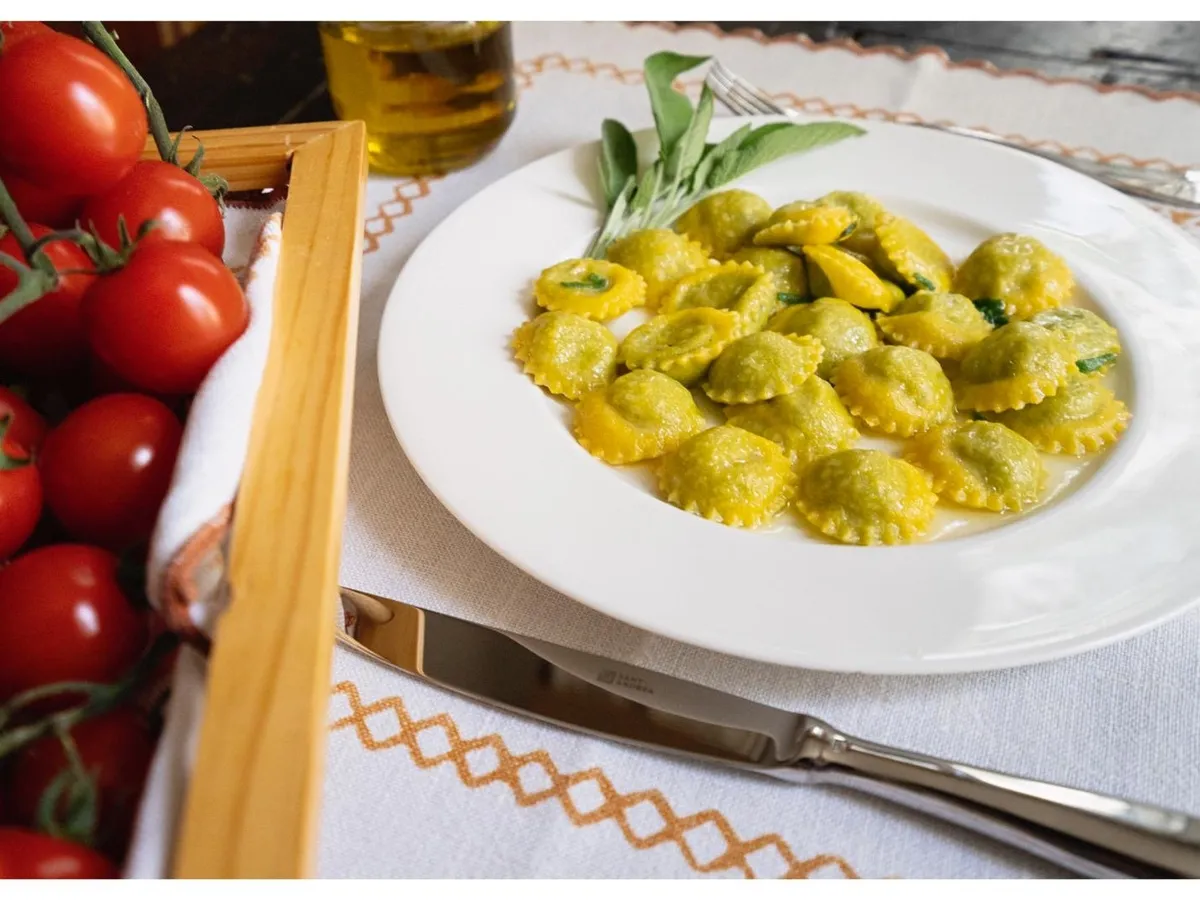
Ravioli di ricotta e spinaci are the filling Romagna uses to teach children how to seal pasta. There is no meat to balance as there is in cappelletti, no pumpkin to dry out: just ricotta, greens, cheese and a grating of nutmeg. And yet it is the simplest ravioli that give away the small mistakes, because a soft filling or a badly closed edge shows up at once on the plate.
We make them square, with a fluted pastry wheel that leaves a lace border, and dress them in summer with a fresh tomato sauce cooked for minutes rather than hours, or with the timeless and always perfect pairing of butter and sage.
The filling: drier is better
The first secret is the ricotta. The fresh one at the counter is beautiful but full of whey, and whey turns into water as the ravioli cook, splitting the sfoglia, the sheet of egg pasta, from the inside. That is why we leave it to drain in a sieve overnight, or at least for an hour, before working it. Sheep ricotta holds up better and has more flavour; cow ricotta is more delicate and asks for more patience at the draining stage. We cut the knot and use a mixed milk ricotta.
The spinach follows the same logic. Cook it with barely any water, squeeze it into a dry ball and chop it with a knife: a blender breaks the fibres and releases liquid. When the mixture holds its shape on the spoon without slumping, it is ready. If it will not get there, an extra spoonful of Parmesan solves it. Here too habits differ from family to family: some chop the spinach raw, others boil it and then toss it in a pan with a knob of butter to drive off every last drop of water.
Sealing without air
The second secret is the closing. A raviolo with a bubble of air inside is a raviolo that floats crooked, swells and splits at the weakest point of the border. To avoid it we fold the sheet over the filling and press with our fingers around each mound, working from the centre outwards, the way you smooth cling film over a tub. Only then do we run the pastry wheel over it.
The sfoglia should be thin but not transparent: around the millimetre, as we explain in the guide to rolling pasta by hand. Too thick and the border stays raw while the middle is cooked; too thin and the moist filling pierces it.
Fresh tomato, or butter and sage
In summer, when the tomatoes are properly ripe, we make a quick sauce with oil or butter, as you prefer, an unpeeled clove of garlic and basil, cooked for ten minutes and done. No heavy soffritto, no tomato purée: the raviolo is delicate and should be accompanied, not drowned. Otherwise, butter and sage suit them perfectly.
At the table
The ravioli go straight from the water into the pan of dressing with a slotted spoon, get tossed for a moment and are served at once with Parmesan grated on the spot. If you have raw ones left over, freezing beats the fridge: the guide to storing and drying fresh pasta explains how to do it without them sticking together.
Ingredients
For the pasta
For the filling
For the dressing
Tick the ingredients as you go. Amounts adapt to the number of servings.
Weigh the eggs, find the flour
Flour type the weight
Filled pasta: weight of the eggs × 1.55, for a more elastic sheet that holds the filling. The rule is in the guide to the basic dough.
Method
-
Draining the ricotta
Put the ricotta in a fine sieve set over a bowl, cover it and leave it in the fridge for at least an hour, better still overnight. The whey that drips out is what would make the filling watery and the sfoglia soft.
-
The spinach
Wash the spinach and cook it in a covered pan with only the water clinging to the leaves for 4 to 5 minutes. Drain it, let it cool a little and squeeze it with your hands into a compact ball. Chop it finely with a knife, not in a blender.
-
The filling
Work the ricotta with a fork in a bowl, then add the spinach, Parmesan, egg yolks, nutmeg, salt and pepper. You want a firm mixture that holds its shape on the spoon. Cover it and keep it in the fridge while you make the pasta.
-
The pasta
Make a well of flour, break the eggs into the middle and draw in the flour a little at a time with a fork. Knead for 10 minutes until the dough is smooth, then wrap it in cling film and rest it for 30 minutes.
-
Rolling and filling
Roll the sheet out thin, about 0.8 to 1 mm, and cut strips 10 cm wide. Place walnut sized mounds of filling 5 cm apart along one half of each strip. A piping bag is a great help here: after a few tries it lets you make mounds that are all the same and, above all, keeps the rest of the sheet clean. Fold the other half over the top and press with your fingers around each mound, working from the filling outwards, to push the air out.
-
Cutting
Cut the squares with a fluted pastry wheel, leaving a border of about a centimetre. Where you cut there must be only doubled pasta, no filling: otherwise the edge will not seal and the ravioli open as they cook. Check every raviolo: if one side is not sealed, dampen it with a wet finger and press again. Lay the ravioli on a floured tray without overlapping them.
-
Cooking and dressing
In a wide pan warm the oil, or melt the butter, with the unpeeled garlic clove; add the tomatoes cut into quarters, salt them and cook for 10 minutes. Take out the garlic and adjust the salt, erring on the mild side. Cook the ravioli in salted water at a light boil for 3 to 4 minutes, lift them into the pan with a slotted spoon, turn the heat back on and toss for a moment with a spoonful of pasta water. Serve with plenty of Parmesan.
Alternative method: with the pasta machine If you roll the sheet with rollers
With the machine the ravioli all come out the same, which is an advantage in the pan: they rise to the surface at the same moment.
- Divide the dough into four pieces and cover three of them.
- At the widest setting fold in three and pass again four times, then go down as far as the sixth or seventh out of nine.
- Roll out two strips of the same length: one is the base, the other the lid.
- Set the filling out in little mounds well spaced, cover with the second strip and press around each mound from the centre towards the edge, to push the air out.
- Trim with the fluted wheel and check the edges one by one before flouring them.
The rolling pin remains our choice: the reason is in the guide to rolling the sfoglia by hand.
Frequently asked questions
Why does the ravioli filling turn watery?
Almost always because the ricotta was not drained or the spinach was badly squeezed. Leave the ricotta in a sieve in the fridge overnight and squeeze the spinach with your hands until no more water comes out. If the mixture is still soft, add a spoonful of Parmesan or breadcrumbs.
How do I stop the ravioli opening as they cook?
The air trapped inside expands with the heat and pushes on the edges. Always press around the filling from the centre outwards, then seal the border with the pastry wheel, cutting where there is only doubled pasta. Cook at a light boil, never over fierce heat.
Can I make the ravioli in advance?
Yes, but do not leave them raw in the fridge for more than a few hours: the moist filling softens the pasta. Better to freeze them at once on the floured tray and move them into a bag once they are hard.
Fresh tomato or butter and sage?
Fresh tomato is our house version: ripe tomatoes cooked for ten minutes with oil or butter, an unpeeled clove of garlic and basil, with no heavy soffritto. Butter and sage is the classic alternative, which lets the ricotta come through: both go perfectly.
Keep kneading
Similar recipes
 Gnocchi
Potato gnocchi with butter and sage
Thursday is gnocchi day
 Tagliolini
Tagliolini with butter and sage
The finest cut of the sfoglia, for a dressing that does not cover it
 Spoja lorda
Spoja lorda
Quicker than cappelletti, every bit as irresistible: the sheet dirtied the proper way