Cappelletti · In broth
Cappelletti in brodo: the Romagna Christmas recipe
The Christmas first course, folded by hand around the table
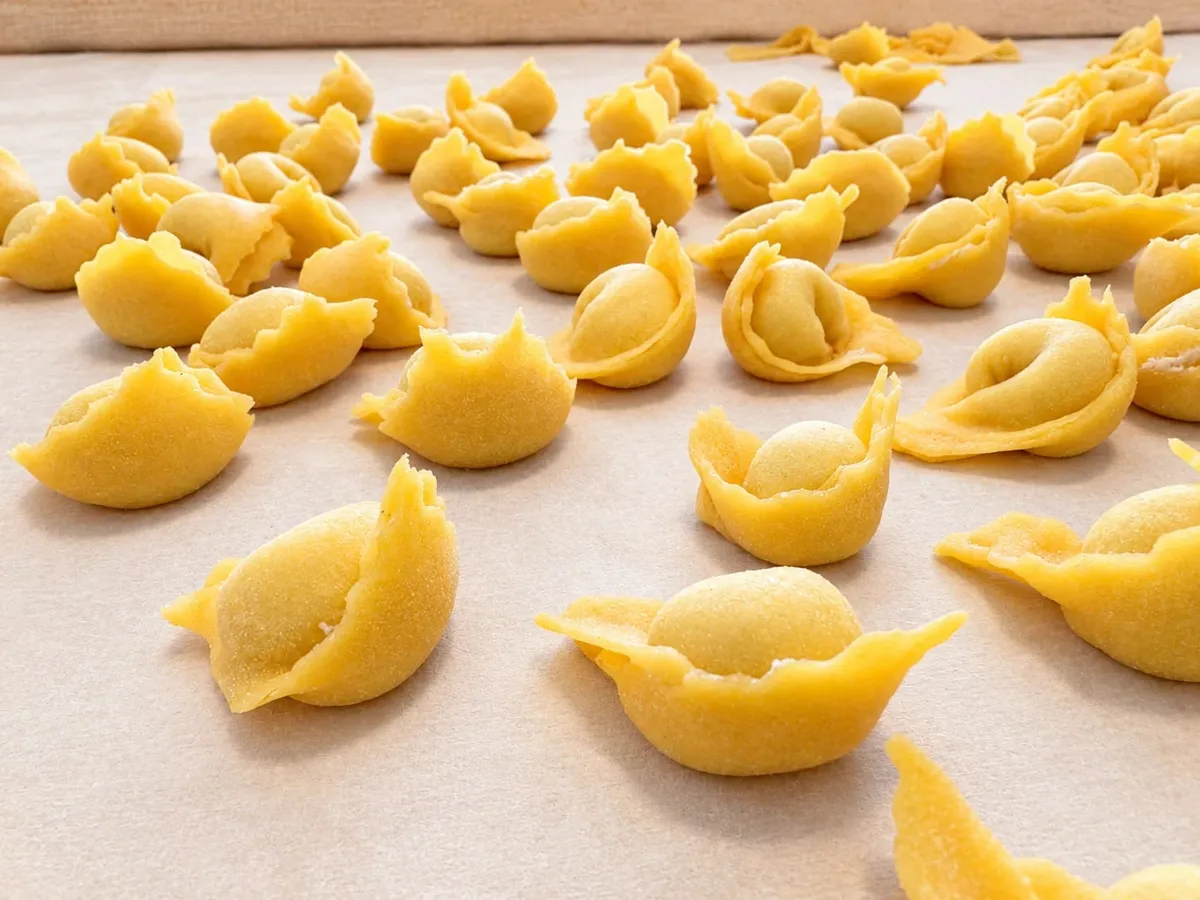
At Christmas in Romagna the table does not begin with the lunch but with the evening before: the sfoglia, the sheet of egg pasta, rolled out on the board, the filling in its bowl, and the whole family sitting down to fold cappelletti for hours. The children learn by watching, the grandparents check that the point is standing straight, and the capon broth perfumes the house all the while. They are the dish of the holidays, the first course of important Sundays and, for many of us, the taste of winter itself.
Cappelletti, not tortellini
People from outside confuse the two, but in Romagna the difference is clear. The Bolognese tortellino is small, closed around the little finger, and filled with meat and cured pork: loin, mortadella, ham. The Romagna cappelletto is bigger, closed around the index finger with the point left standing like a hood. For Pellegrino Artusi, who came from Forlimpopoli, the traditional filling is di magro, meaning meatless, made of cheese: he wrote it down as early as 1891, the filling of cappelletti in the Romagna style is cheese, egg and nutmeg, with capon breast added by those who could afford it. The truth is that Romagna has at least three versions of the filling, and the people of every town will assure you that theirs is the only original one. For the whole story, see our article on cappelletti or tortellini.
So, coming back to us, who are from Rimini: this is our Christmas cappelletti recipe, with the meat roasted, then ricotta and Parmigiano.
The broth makes the difference
A perfect cappelletto in a mediocre broth is a wasted meal. What you want is a double broth, capon and beef, started from cold water and never allowed past a tremble: three hours over a low flame, patiently skimmed, then degreased once cold. If it is not Christmas and there is no capon to be had, a boiling hen does the same job. The same broth, with stale bread, becomes the base for passatelli the next day.
The sfoglia and the fold
The sfoglia for cappelletti is thinner than the one for tagliatelle, otherwise where it overlaps in two or four layers it stays raw or rubbery. In the guide on rolling pasta by hand we explain how to feel the right thickness with your hands. The fold cannot be learned by reading: the first twenty come out ugly, and from the twenty first onwards your hand finds the gesture and never forgets it.
The quantities above are for five medium eggs, but what we really do is weigh the eggs out of their shells and multiply by 1.55: it is the formula for filled pasta, and we explain it in the guide to the basic sfoglia dough.
At the table
Cappelletti are served in their boiling broth, in warmed deep bowls, with Parmesan on the side. For the rest of the holiday menu, read our Christmas in Romagna.
Ingredients
For the broth
For the pasta
For the filling
Tick the ingredients as you go. Amounts adapt to the number of servings.
Weigh the eggs, find the flour
Flour type the weight
Filled pasta: weight of the eggs × 1.55, for a more elastic sheet that holds the filling. The rule is in the guide to the basic dough.
Method
-
The broth
Put the capon, the beef and the bone into a tall pot with the cold water. Bring it slowly to the boil, skim carefully, then add the vegetables, the tomatoes and a handful of coarse salt. Leave it to simmer uncovered for three hours: it should barely tremble, never boil hard, or it will turn cloudy.
-
The filling
Set the ricotta to drain in a fine sieve. Melt the butter with the sage in a heavy pan, then brown the meat in whole pieces, as you would for a stew: once it is golden on the outside, deglaze with the cognac, season with salt and pepper and carry on cooking, covered, over a low flame for forty minutes. Take the lid off and let the juices reduce. Turn off the heat and let it cool completely. When the meat is at room temperature mince it very finely, with a mincer if you have one, otherwise in a food processor, a little at a time. Tip it into a large bowl, add all the other ingredients and mix until it comes together into an even paste; with a stand mixer use the paddle on low speed, just long enough to combine. It must be firm and compact: cover it and leave it in the fridge for half an hour.
-
The pasta
Make a well with the flour, break the eggs into the middle and draw the flour in a little at a time with a fork. Knead with the heel of your hand for 10 minutes until the dough is smooth. Wrap it in cling film and let it rest for 30 minutes.
-
Rolling and cutting
Roll the sfoglia thin but not see through, flouring it as little as you can. Cut squares of 4.5 to 5 centimetres. Work on a few squares at a time and keep the rest of the sheet covered, because dry pasta will not seal.
-
Folding the cappelletti
Put a hazelnut of filling in the centre of each square. Fold it into a triangle and press the edges firmly. Take the triangle with the base towards you, wrap it around the tip of your index finger and press the two ends together hard. The point stays up, like a little hat.
-
Drying
Lay the cappelletti on floured trays, or trays lined with baking paper, without letting them touch, and leave them to dry for at least an hour somewhere cool. Meanwhile strain the broth and skim off the fat.
-
Cooking
Bring the broth to a gentle simmer and drop the cappelletti in. They are ready after four or five minutes, when they all float and the pasta at the edges is tender. Serve them in their own broth.
Alternative method: with the pasta machine If you roll the sheet with rollers
For cappelletti the machine helps, because the sfoglia has to be really thin. The only care it takes is to work quickly: the sfoglia for filled shapes must not dry out, or it will not seal.
- Divide the dough into six small pieces and keep them under a tea towel: you work on one at a time.
- Pass it through the widest setting, fold in three and pass it again four times, then go down one setting at a time.
- Go as far as the eighth or ninth out of nine: held up to the light, the sfoglia should let the colour of the filling show through.
- As soon as the strip comes out, cut squares of 4.5 to 5 cm and fill them straight away. Cover with cling film whatever you are not closing.
- Close them as in the hand method: a triangle, edges sealed and a turn around your index finger.
The rolling pin remains our choice: the reason is in the guide to rolling the sfoglia by hand.
Frequently asked questions
What is the difference between cappelletti and tortellini?
The Romagna cappelletto is bigger and is closed around the index finger, with the point left standing; the Bolognese tortellino is tiny, closed around the little finger, and filled with pork loin, mortadella and ham. As for what goes inside a cappelletto there is no single rule: Artusi gave it as cheese, in Rimini we make it with roast meat, ricotta and Parmigiano.
What meat goes into a cappelletti filling?
In the Rimini version, equal parts pork loin, veal and capon breast. They are browned whole in butter with sage, deglazed with cognac and cooked covered for forty minutes; then they are minced very finely and worked together with drained ricotta, Parmigiano, eggs and nutmeg.
How many cappelletti per person?
The house rule in Romagna says 25 to 30 cappelletti each, which is roughly 80 to 100 grams. These quantities make 200 to 220, enough for six generous portions as Christmas lunch demands, or eight ordinary ones.
How far ahead can I make them?
The day before, left to dry on a floured tray under a tea towel somewhere cool. The broth can be made two days ahead and kept in the fridge: skimming the fat off when it is cold is far easier.
Keep kneading
Similar recipes
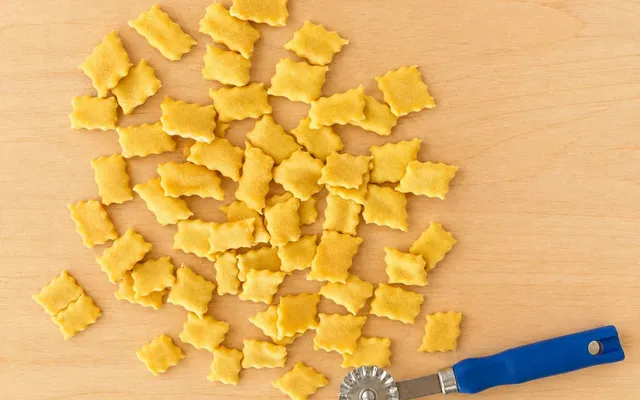 Spoja lorda
Spoja lorda
Quicker than cappelletti, every bit as irresistible: the sheet dirtied the proper way
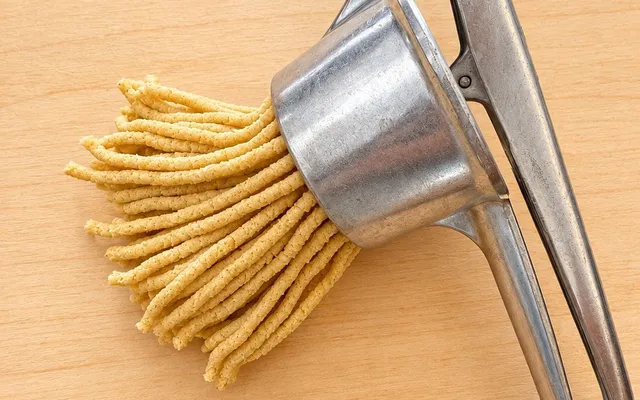 Passatelli
Passatelli in brodo
Bread, cheese and eggs: the broth of feast days and leftovers
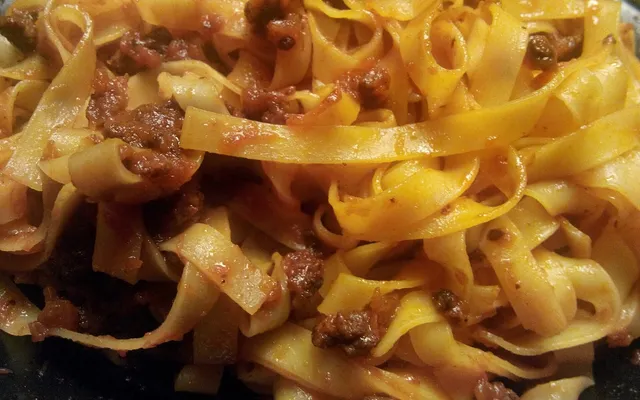 Tagliatelle
Tagliatelle al ragù
The Sunday dish, the way our grandmother made it